Brainrot-what? Why big businesses are betting big on Italian AI chaos
If the names “Ballerina Cappuccina”, ”Tralalero Tralala,” and “Tung Tung Tung Sahur” sound simultaneously vaguely familiar, kind of catchy, and downright nonsensical, you’re not alone. What they all have in common is that they are names of Italian AI Brainrot characters. But what exactly does that even mean, and why do companies care?
What is Italian AI brainrot?
Brainrot is Gen Alpha and Gen Z’s new sense of humor. The Oxford University Press chose it as the 2024 word of the year, defining it as online content that is “trivial or unchallenging” and leads to the “supposed deterioration of a person’s mental or intellectual state,” explaining the absurdist nature of these words.
The exact origin of these Italian AI characters is hard to pinpoint. In fact, it might not even be Italy. None of the words are actually Italian, though they sound like a stereotype of the language. Each character’s appearance is clearly AI-generated based on the name. Ballerina Cappucino, for example, is a ballerina with an anthropomorphized cappuccino cup as a head. The content features these surrealist characters, often incorporating flame effects, quick transitions, AI-generated videos, eerie music, and a distinct, masculine voiceover. Most importantly for companies, this content is key to capturing the hearts and attention spans of young audiences.
How companies are leveraging it
Companies across various industries are leveraging the AI Brainrot. Even RyanAir, with its strong TikTok presence, hopped on the trend. One YouTube Short features an animation of a Ryanair plane landing in a place called “Trallalero Trallala,” complete with a photoshopped image of Trallalero Trallala set in the European countryside. The comments section is overwhelmingly positive, with users leaving comments like “The fact that I’m gonna fly with RyanAir soon is so cool” and “Best airline.”
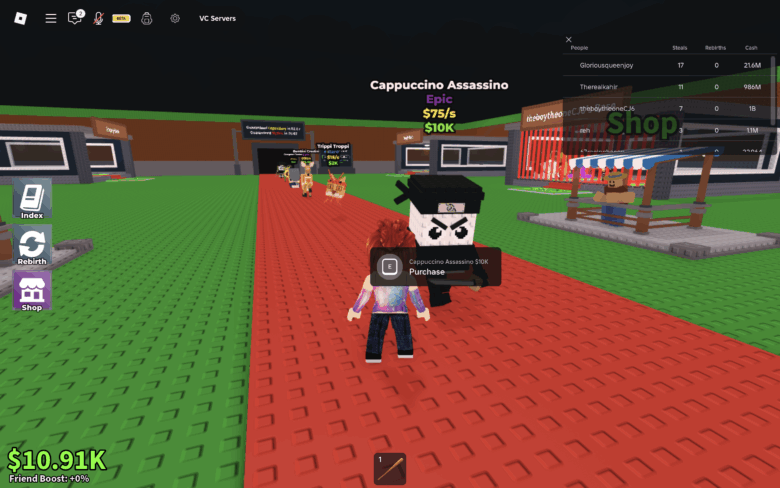
Roblox
A Roblox community game titled “Steal A Brainrot” broke records on the platform, bringing in almost 24 million players in one day. At the Roblox Innovation Awards, the game took home the prize for “Best Creative Direction.” When Epic Games licensed it for adaptation in the Fortnite video game, it attracted five times more users than their other game modes, such as Battle Royale. Evidently, tech- and gaming-focused consumers are drawn to the trend.

ScrubDaddy
Companies don’t need to directly reference the AI Brainrot characters to capitalize on the trend. This TikTok from ScrubDaddy incorporates multiple elements of classic brainrot videos, such as over-the-top special effects filters and popular AI-generated audio. An Empire State Building TikTok utilizes the same abrupt transitions, AI-generated images of the Empire State Building made of pizza, and a faux-Italian voiceover. From tourism to gaming to travel, all these brands used Italian AI Brainrot and its components to connect with their young, social media-savvy audiences.
Why it works — and when it doesn’t
For younger audiences, there’s much to love about brainrot content. With its fast-paced edits and transitions, it holds their 8-second attention spans. It captures the internet humor of the generations, which is characterized by irony, layered nuance, and absurdity. For generations that have experienced multiple life-changing disasters — COVID, climate change anxiety, and a growing mental health crisis, to name a few — brainrot allows them to “turn their brain off” and relax.
It’s no surprise that Gen Z seeks this out in the brand content they consume. This is evident in the comical, quirky brand voices, such as Scrub Daddy, Ryanair, and Duolingo, which have become increasingly prominent in recent years. It’s more than humor, though. Gen Z craves authenticity, and that’s where AI gets dicey. 53% of adult Gen-Z say they feel “anxious” about AI, citing concerns about critical thinking and creativity.
This is excruciatingly apparent in an AI-generated ad from the mental health app Liven. The song and animation are all AI-generated. Comments on a YouTube video of the ad are overwhelmingly negative, with users calling it “crooked” and “a literal dystopia,” with one person saying, “I wish these ads would eat dirt.” The ad even garnered negative attention on the r/CommercialsIHate subreddit. Evidently, overreliance on AI, especially in serious contexts such as mental health, can be off-putting to viewers.
Conclusion
Italian AI Brainrot, along with all its unique components, might be the key to winning over Gen-Z and Gen-Alpha audiences. However, as always, there are caveats and nuances that add a tricky element to the trend. There’s a balance between making AI into humor and using AI to make humor. It requires a careful understanding of tone, contextual awareness, and the complex relationship young people have with new technology. When done correctly, as multiple brands have demonstrated, it can be a valuable tool to attract a digital-native audience.
- Related: 6 steps to train an AI model to do whatever you want
- Related: The SEO Trends That Could Help Your Business Grow
Like MediaFeed’s content? Be sure to follow us.
This article was syndicated by MediaFeed.org.
AlertMe