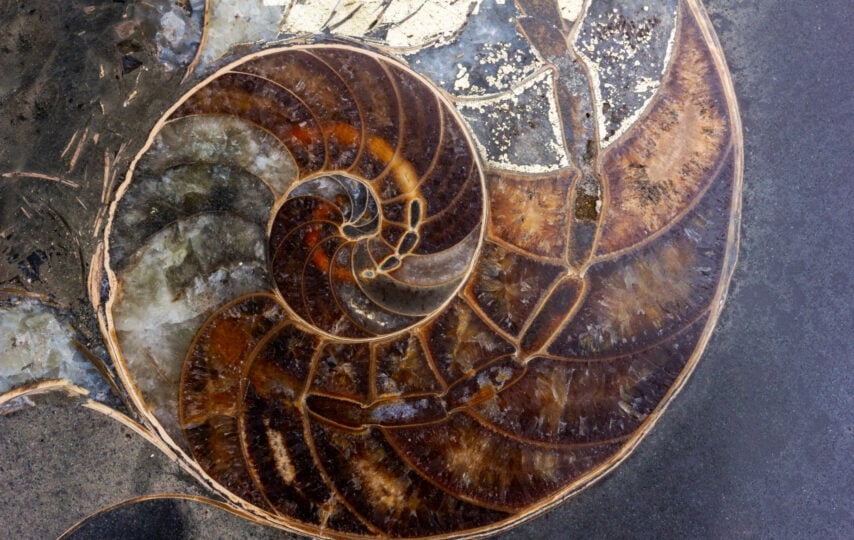

If you don’t know what Fibonacci day is then go now and have a look at the calendar, write today’s date in the Month/Day format (11/23), you’ll notice a pattern, the first four digits of the famous sequence (1, 1, 2, 3). The sequence is the key to the Golden Ratio, one of the most famous proportions. It’s the secret code behind the spirals of galaxies, the unfurling of ferns, and the perfection of the sunflower.
Fibonacci day honors the medieval Italian mathematician Leonardo Pisano (c. 1170–c. 1250), who was better known by his nickname, Fibonacci. His sequence is a series of numbers where each number is the sum of the two preceding ones. Starting typically with 0 and 1 (or 1 and 1 for the 11/23 date pattern), it looks like this:
0, 1, 1, 2, 3, 5, 8, 13, 21, 34, 55, 89, etc..
Fibonacci described the sequence in his 1202 book, Liber Abaci, The Book of Calculation, using it to solve a thought puzzle about the growth of a rabbit population.
The puzzle he used was in his argument was this, if there are a pair of newly born rabbit – male and female – in the field and if they are able to produce another pair of rabbits in their second month of life, how many pairs of rabbits will be there after a year?
The sequence is often represented visually by the Golden Spiral, a logarithmic spiral that gets wider by a factor of Phi for every quarter-turn. This spiral can be constructed by drawing arcs in a sequence of squares whose sides correspond to Fibonacci numbers.
But why is this sequence celebrated? Because it’s Nature’s Universal Rule, and if you look closer, it actually appears everywhere!
The Golden Ratio and Fibonacci numbers appear repeatedly in nature, for example the spiral arrangement of seeds in a sunflower, the scales on a pinecone, and the florets of a Romanesco broccoli often have spirals that match consecutive Fibonacci numbers (like 21 and 34, or 34 and 55). This spacing maximizes light exposure for growth.

Image Credit: Racide/iStock
The spiral shape of a nautilus seashell closely follows the logarithmic growth pattern of the Golden Spiral. Also, some human body proportions, such as the ratio of the forearm to the hand, or the sections of your fingers, are said to approximate the Golden Ratio.
In Architecture, we can see the ratio in the proportions of the Parthenon in Greece and the layout of the Great Pyramids of Giza.
And for sure, we can see the ratio in various art works and it was largely used by many famous artists, for example in Renaissance art, particularly Leonardo da Vinci, in the arrangement of his painting The Last Supper and his drawing Vitruvian Man, the composition is analyzed through the lens of the Golden Ratio, which artists at the time called the “Divine Proportion.”
So on the 23rd of November, we celebrate a sequence of numbers, derived from a 13th-century rabbit puzzle that simply holds the secret code to beauty in the universe.
Happy Fibonacci day!
Related:
- Analog lessons for a digital world: Living slower, feeling fuller
- The Venezuelan sinkhole that shouldn’t exist
Like MediaFeed’s content? Be sure to follow us.
This article was produced and syndicated by MediaFeed.us.
AlertMe