5 archaeological finds made by amateurs: The unsung heroes of discovery
In 2009, Terry Herbert, an unemployed metal detectorist in Staffordshire, England, swept his detector over a freshly plowed field and received a signal. What he unearthed over the following days would become the most extensive collection of Anglo-Saxon gold ever discovered (over 3,500 pieces of intricate metalwork that had lain hidden for more than 1,300 years). Herbert’s discovery, made with a second-hand metal detector, transformed our understanding of Anglo-Saxon England and demonstrated a profound truth about archaeology: some of history’s most significant discoveries come not from professional excavations, but from ordinary people going about their daily lives.
While professional archaeology employs rigorous scientific methods, sophisticated technology, and years of specialized training, many of history’s most transformative discoveries have been made by farmers, shepherds, soldiers, and hobbyists who stumbled upon artifacts by chance or through amateur pursuits.
These accidental archaeologists have played a vital role in uncovering the past. From ancient manuscripts hidden in desert caves to vast underground armies of terracotta warriors, amateur discoveries have revolutionized our understanding of human civilization, proving that the keys to unlocking history’s mysteries can be found by anyone, anywhere, at any time.

Birmingham Museum and Art Gallery / Wiki Commons
The Staffordshire Hoard (2009)
Terry Herbert had been metal detecting for 18 years without finding anything of significant value when, on July 5, 2009, he obtained permission to search a farmer’s field in Hammerwich, Staffordshire. What began as a routine hobby turned extraordinary as his detector repeatedly signaled the presence of metal objects just below the surface. Over five days, Herbert unearthed piece after piece of gold and silver, eventually realizing the magnitude of his discovery and immediately contacting the local Finds Liaison Officer as required by British law. Professional archaeologists soon arrived to conduct a systematic excavation that would ultimately recover more than 3,500 items weighing over 5 kilograms of gold and 1.4 kilograms of silver.
The Staffordshire Hoard represents the most extensive collection of Anglo-Saxon gold and silver metalwork ever found, dating to the 7th or 8th century. The artifacts consist primarily of military equipment, including sword fittings, helmet fragments, and warfare regalia decorated with intricate patterns and Christian imagery, suggesting they may have been spoils of war or a king’s treasure. The discovery has provided unprecedented insight into Anglo-Saxon culture, warfare, craftsmanship, and the transition period when pagan warriors were converting to Christianity. The hoard has fundamentally changed scholarly understanding of Anglo-Saxon metalworking techniques and the wealth and military sophistication of kingdoms during this period. Many pieces are now displayed at museums in Birmingham and Stoke-on-Trent, allowing the public to connect with this remarkable chapter of English history.

Israel Antiquities Authority / Wiki Commons
The Dead Sea Scrolls (1947)
In early 1947, a young Bedouin shepherd named Muhammed edh-Dhib was tending his flock of goats and sheep in the rugged cliffs near Qumran, along the northwestern shore of the Dead Sea. According to the most widely accepted account, he threw a stone into a cave opening while searching for a lost animal and heard the sound of breaking pottery. Investigating the cave, he discovered several large clay jars containing ancient leather and papyrus scrolls wrapped in linen. Not immediately recognizing their significance, Edh-Dhib and his companions eventually brought some scrolls to an antiquities dealer in Bethlehem, setting in motion one of the most important archaeological discoveries of the 20th century.
The Dead Sea Scrolls comprise approximately 900 documents, including ancient religious manuscripts that represent some of the oldest known copies of biblical texts, dating from the third century BCE to the first century CE. Among the scrolls are complete and fragmentary copies of every book of the Hebrew Bible except the Book of Esther, as well as previously unknown religious texts, prayers, and sectarian documents likely produced by a Jewish community, possibly the Essenes, who lived in the area. The discovery revolutionized biblical scholarship by providing manuscripts roughly 1,000 years older than previously known Hebrew texts. This allowed scholars to trace the evolution of biblical texts and demonstrated remarkable consistency in their transmission across centuries. The scrolls have profoundly impacted our understanding of the history of Judaism, the origins of Christianity, and the religious and political landscape of ancient Judea during a pivotal period of human spiritual development.

Wiki Commons
The Venus de Milo (1820)
On April 8, 1820, Yorgos Kentrotas, a peasant farmer on the Greek island of Milos (then called Milo), was working his land when he uncovered a niche carved into rock that contained two pieces of a marble statue. The statue depicted a female figure with classical Greek features, though it was missing both arms and the original plinth that would have identified the subject. Kentrotas recognized that the sculpture was likely ancient and of potential value, and word of the discovery quickly reached a French naval officer, Olivier Voutier, who happened to be visiting the island. Through a series of negotiations involving French diplomats and Turkish officials (as Greece was then under Ottoman control), the statue was eventually acquired by France and presented to King Louis XVIII, who donated it to the Louvre Museum.
The Venus de Milo, as the statue became known, is believed to represent Aphrodite, the Greek goddess of love and beauty, and dates to approximately 130-100 BCE, during the Hellenistic period. Standing over six feet tall and carved from marble in multiple pieces, the sculpture exemplifies the classical Greek ideal of beauty. It has become one of the most famous and iconic artworks from antiquity. The statue’s missing arms have inspired centuries of scholarly debate and public fascination about its original pose and the objects it may have held. As a cornerstone of classical art history and one of the Louvre’s most prized exhibits, the Venus de Milo has influenced countless artists, served as a symbol of classical Greek civilization, and demonstrates how a chance discovery by a farmer could preserve and share a masterpiece that might otherwise have remained buried and lost to history.

Wiki Commons
The Terracotta Army (1974)
In March 1974, a group of Chinese farmers in Lintong District, Shaanxi Province, were digging a well during a severe drought when their shovels struck something hard beneath the soil. Led by Yang Zhifa, the farmers unearthed fragments of terracotta clay, including what appeared to be a human head and body parts. Initially unsure of what they had found, the farmers reported the discovery to local authorities, who dispatched archaeologists to investigate. What those archaeologists uncovered was nothing short of astonishing: an enormous underground complex containing thousands of life-sized terracotta sculptures of soldiers, horses, and chariots, arranged in military formation.
The Terracotta Army consists of over 8,000 soldiers, 130 chariots with 520 horses, and 150 cavalry horses, most of which are still buried in three main pits covering an area of more than 20,000 square meters. Created around 210-209 BCE to accompany China’s first Emperor, Qin Shi Huang, into the afterlife, each figure was individually crafted with unique facial features, expressions, and details in their armor and clothing, demonstrating extraordinary artistry and organizational capability. The discovery is considered one of the most significant archaeological finds of the 20th century, providing a stunning and unprecedented look into ancient Chinese military organization, artistic practices, manufacturing techniques, and beliefs about death and the afterlife. The site has become one of China’s most significant tourist attractions and a UNESCO World Heritage Site. It has fundamentally changed our understanding of the Qin Dynasty and the emperor who unified China. At the same time, Yang Zhifa and his fellow farmers are celebrated as the discoverers who revealed this wonder to the world.
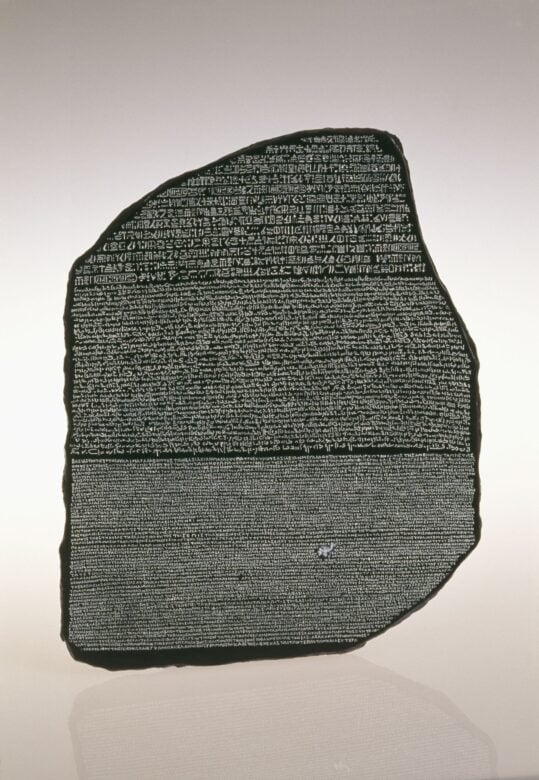
Image Credit: gyro / iStock.
The Rosetta Stone (1799)
In July 1799, during Napoleon Bonaparte’s Egyptian campaign, French soldiers were strengthening the defenses of Fort Julien near the town of Rashid (Rosetta) in the Nile Delta when Lieutenant Pierre-François Bouchard, an officer of engineers, noticed an unusual stone built into an old wall. The stone was a fragment of a larger stele, measuring about 44 inches tall and 30 inches wide, and it was covered with three distinct bands of inscriptions in different scripts. Bouchard immediately recognized the potential significance of a trilingual text and reported the find to General Jacques-François Menou, who ordered that the stone be transported to Cairo for scholarly examination.
The Rosetta Stone contains a decree issued in 196 BCE during the Ptolemaic dynasty, inscribed in three scripts: Ancient Egyptian hieroglyphs, Demotic script (the common writing system of Egypt at the time), and Ancient Greek. Because scholars could read Ancient Greek, the stone provided the crucial key to deciphering Egyptian hieroglyphs, a writing system that had remained mysterious for centuries after the knowledge of how to read it was lost. The breakthrough came in 1822 when French scholar Jean-François Champollion used the stone’s parallel texts to crack the hieroglyphic code, unlocking thousands of years of ancient Egyptian history, literature, and culture that had been inaccessible. The Rosetta Stone, now housed in the British Museum after being seized when British forces defeated the French in Egypt, represents one of the most important linguistic discoveries in history and demonstrates how a chance observation by a soldier could provide the master key to an entire civilization’s written records.

Emrah Gokcan / iStock
The dynamics of amateur and professional collaboration
The discoveries highlighted above share a crucial common element: in each case, the amateur discoverer recognized the potential significance of what they had found and reported it to authorities or experts who could properly document, preserve, and study the artifacts. The importance of reporting cannot be overstated. Many significant archaeological finds have been damaged or lost to history because finders failed to involve professionals, kept artifacts privately, sold them on the black market, or inadvertently destroyed context through amateur excavation. When amateurs immediately report finds and allow professional archaeologists to conduct systematic excavations, the scientific value of discoveries is maximized.
The relationship between amateur discoverers and professional archaeology involves important ethical considerations and legal frameworks that vary by country. The debate between “treasure hunting” motivated by profit and “responsible discovery” driven by historical preservation has led many nations to develop comprehensive systems for managing archaeological finds. The United Kingdom’s Portable Antiquities Scheme exemplifies best practices by encouraging metal detectorists and others to voluntarily report finds, providing expert identification and recording, and offering rewards for significant discoveries while keeping finders engaged in the archaeological process. Such collaborative approaches benefit all parties: amateurs gain recognition and sometimes financial compensation, professionals obtain valuable data and artifacts that might otherwise go unreported, museums acquire important objects for public display and study, and society as a whole gains a deeper understanding of its heritage. The partnership between amateur enthusiasm and professional expertise, when built on mutual respect and clear ethical guidelines, creates a powerful force for uncovering and preserving humanity’s shared past.

EyeEm Mobile GmbH / iStock
Conclusion
The remarkable discoveries of the Staffordshire Hoard, Dead Sea Scrolls, Venus de Milo, Terracotta Army, and Rosetta Stone demonstrate that history is not exclusively the domain of professional archaeologists working on planned excavations. These transformative finds, made by an unemployed metal detectorist, a young shepherd, a peasant farmer, well-digging farmers, and a soldier, have fundamentally reshaped our understanding of Anglo-Saxon England, ancient Judaism and Christianity, classical Greek art, imperial China, and Egyptian civilization. Each discovery illustrates how ordinary people, through chance encounters or amateur pursuits, have contributed immeasurably to humanity’s knowledge of its past, often opening entirely new chapters in archaeological and historical scholarship.
The stories of these amateur archaeologists carry a powerful message: every citizen has the potential to contribute to our collective understanding of human history, one chance discovery at a time. Whether walking through a plowed field with a metal detector, tending sheep near ancient caves, working the land, digging a well, or serving in a military campaign, ordinary people encounter the physical remnants of past civilizations and hold in their hands the power to preserve or lose pieces of our shared heritage.
Related:
- Historical “discoveries” that turned out to be elaborate hoaxes
- Ancient “technologies” that still have scientists baffled
Like MediaFeed’s content? Be sure to follow us.
This article was syndicated by MediaFeed.org.
AlertMe