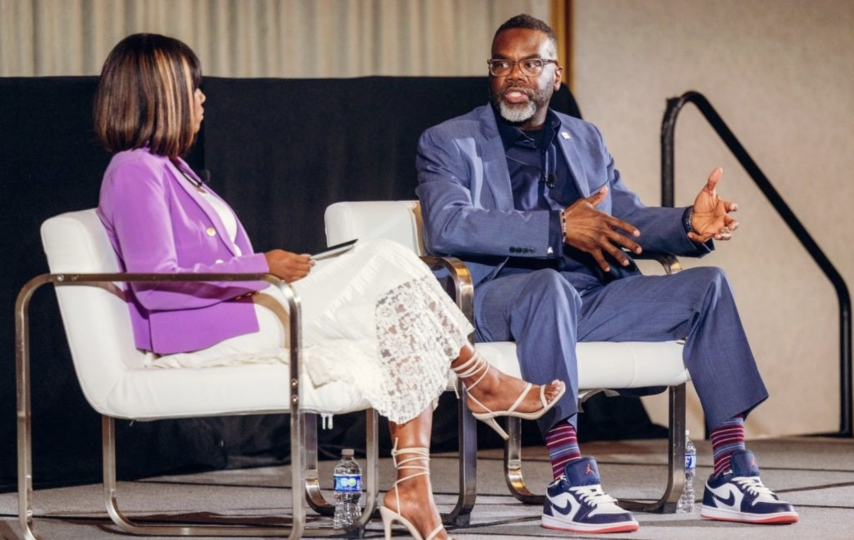
The mayor seemed to go out of his way this week to credit independent media, particularly Block Club Chicago, an independent digital outlet with an emphasis on ground-level reporting, for serving the city well in defining itself as a paragon of resistance to Trump. Johnson pointed out that journalists at Block Club and other organizations have courageously documented the actions of masked federal agents who stormed the city in riot gear and armored vehicles late last year and who have continued to carry out illegal searches and arrests that resulted in constitutional violations of due process.
On the sidelines of the conference, I met up with Jen Sabella, a co-founder and co-executive editor of Block Club. A Chicago native like most of the staff, she told me how Block Club rose out of the ashes of what was known as DNAInfo, an online news startup that lasted five years until 2017, when local billionaire Joe Ricketts suddenly pulled the plug.
A few months after the bad news, DNAinfo editors, including Sabella, Shamus Toomey and Stephanie Lulay, committed to continuing their mission and started Block Club Chicago. It derives its name from a traditional Chicago neighborhood association – blocks within neighborhoods that band together to share information and improve the community. Block Club Chicago’s stated mission remains then as now “to build community through truly ground-level reporting of the city’s neighborhoods.”
It’s a simple idea, and a profound one. They have built a local news organization that structurally begins at the very foundational unit of each city neighborhood, and then built itself up block by block.
Two major crises, Sabella said, shaped the organization’s identity and created a huge opportunity for them to be of service: COVID in 2020 and the ICE raids last year known as Operation Midway Blitz. Both of these huge national stories required trusted and verified information. They made the truth a valuable commodity that could be the difference between life and death during the pandemic, or between freedom and deportation during the sweep by ICE.
It was the kind of information that could be most effectively gathered from a hyper local approach, and while Block Club may have discovered its voice in 2020, five years later it learned power chords that resonate across the city.
Block Club now covers 50 of the city’s 77 community areas, and is continually adding reporters. Back in 2019, they were one of the earliest newsrooms to host Report for America corps members, and became a trusted partner throughout many years. They hosted four corps members, two of whom became full-time staff members after the end of their service, and hired Manny Ramos, a former corps member from RFA’s first full cohort, as an investigative reporter. Right now, the staff is at more than 40 with reporters covering several neighborhoods at a time. It sustains its growth by directly appealing to the community to support local journalism. It steers away from a beat structure, and instead focuses on reporters who cover everything in one patch of the city, from housing to education and health.
There are 20,000 paying subscribers who can join at a number of different tiers. The basic subscription offers not only unlimited access to the site’s reporting but also newsletters written by the neighborhood reporters offering additional information and story links. At the same time, Block Club continues to keep much of its reporting out of the paywall, particularly when it comes to public service reporting such as the work they did on the pandemic or in alerting the community how to be aware of the presence of ICE in different neighborhoods.
Foundations have also provided crucial support, including the McCormick Foundation, which aims to boost the site’s investigative reporting, and the American Journalism Project, which supported the hiring of five staffers to focus on raising revenue.
Tim Franklin, a dean and professor on local news at the Medill School of Journalism, Media, Integrated Marketing and Communications, in an interview with Poynter did not mince words in praising Block Club Chicago as “one of the most successful local digital news startups in the nation in the last five years and there are lessons to be learned in its growth.”
Franklin explained, “First and foremost, Block Club understands its audience and listens to its readers, and it’s been very disciplined about staying laser-focused on serving their needs and interests. Block Club is not trying to be the (Chicago) Sun-Times or the Tribune. It’s figured out how to fill a void in the market covering unique, hyperlocal news across the city.” Join the GroundTruth community
“And, importantly, the leadership team there has been entrepreneurial in building its business model — a diversified mix of crowdfunding, reader revenue, advertising, merchandise and philanthropy. They’ve built a journalistic and financial model with legs, and one that could be replicated elsewhere, especially in densely populated urban areas.”
Block Club Chicago was in the vanguard of using federal government data, obtained through the Freedom of Information Act, to contravene the Trump administration narrative that those arrested were violent criminals, or “the worst of the worst” as Trump repeatedly claimed. They also partnered with other new digital organizations, such as The TRiiBE, an award-winning, independent Black-owned newsroom, and Borderless, a magazine that according to its website is “reimagining immigration journalism for a more just and equitable future,” to work together to serve their community. As Sabella puts it, “Collaboration is everything.”
At the end of last year, Block Club Chicago revealed that roughly two-thirds of those arrested by ICE in Illinois had no criminal history prior to their arrests. Instead, the majority of the arrests were what was known as “collateral arrests” of people rounded up without sufficient probable cause.
In my ongoing tour of local newsrooms we have heard distressing stories about the dismantling of once proud institutions of journalism, but also inspiring stories like Block Club’s. Their experience shows that there isn’t one formula to succeed in local news. The key takeaway is to listen to your audience and adapt your model to their needs.
When asked about how Block Club was successfully serving the communities of Chicago and finding a sustainable business model in doing so, Sabella said “our long standing presence in the community really helped us here.”
It’s pretty simple, she explained, “we are all from Chicago and care deeply about Chicago, and I think the future needs to be that. It needs to be local people serving their local community. I think that is the most likely way to connect with the community and find success.”
Related:
Like MediaFeed’s content? Be sure to follow us.
This article originally appeared on Charlessennott.substack.com and was syndicated by MediaFeed.org