
How (the disastrous) Woodstock ’99 changed mega-festivals forever
Summer arrived in 1999 with bold promises of nostalgia. Organizers Michael Lang and John Scher planned to resurrect the magic of 1969, marking thirty years since half a million gathered for three days that defined a generation. Esquire puts forward that the event was “held at a former air force base in Rome, upstate New York,” where “despite the festival arising from the peace and love ethos of the ’70s, this ’90s event was commercialised to the hilt.” What started as a love letter to the sixties became a cautionary tale for the 2000s. Netflix’s documentary “Trainwreck: Woodstock ’99” has since revived public fascination with this cultural disaster.
The promise
Woodstock ’99 attracted mammoth expectations. The lineup read like a late-nineties fever dream: Red Hot Chili Peppers, Korn, Limp Bizkit, and Alanis Morissette representing an era’s raw energy and angst. Promoters marketed Woodstock nostalgia to Generation X with the fervor of door-to-door salesmen. Rolling Stone notes that organizers created “a festival site built atop hot tarmac in late-July heat” with “exorbitant ticket prices to costly water bottles.” At the same time, “many problems plagued Woodstock ’99, and some severe overcrowding exacerbated them all.” Early warning signs about infrastructure failures were studiously ignored by organizers, who fixated on profit margins rather than participant welfare.
The reality
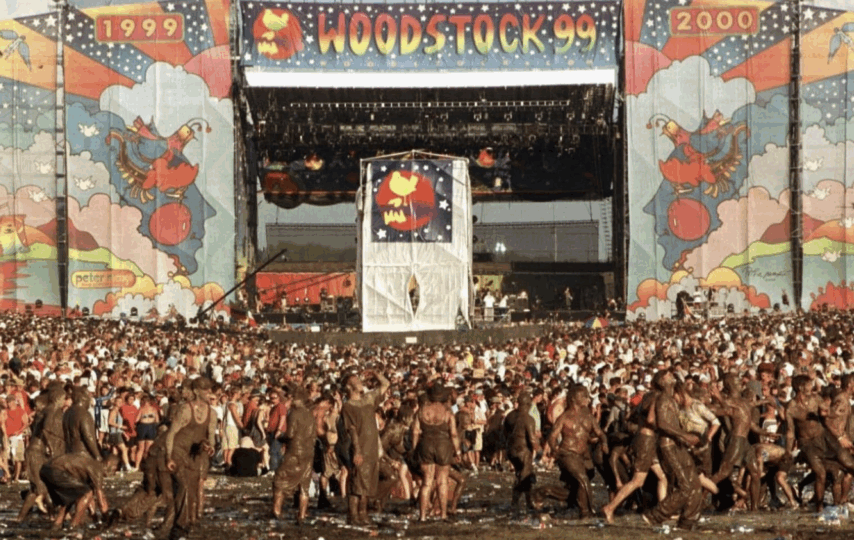
Griffiss Air Force Base became an inferno. Temperatures soared past 100 degrees while attendees trudged across scorching tarmac between stages. Water bottles commanded four dollars apiece (roughly seven in today’s currency) while facilities deteriorated into hazardous cesspools. Broken plumbing created rivers of sewage. Corporate sponsors plastered their logos everywhere: Pepsi, MTV, and a dozen others transformed what should have been a communal space into a transactional one. The brutal conditions tested human endurance beyond reasonable limits.
Violence
Specific performances became lightning rods for rage. Limp Bizkit’s “Break Stuff” on Saturday night ignited simmering tensions into outright chaos. Concertgoers ripped wooden panels from structures, hurled debris at performers, and turned mosh pits into danger zones. By day three, fires erupted throughout the grounds. Attendees looted vendor trailers, overturned vehicles, and torched the very towers meant to broadcast the festival. Police and security forces found themselves overwhelmed by sheer numbers and escalating aggression. The Red Hot Chili Peppers played their closing set amid apocalyptic scenes, with fires burning behind them.
The aftermath
Media coverage erupted with righteous fury. Organizers deflected blame while survivor accounts painted horrifying pictures of sexual assaults, heat casualties, and systemic neglect. Future large-scale Woodstock attempts, including the failed Woodstock 50 in 2019, never materialized. The disaster fundamentally tarnished Woodstock’s legacy and signaled the demise of naive festival idealism, replaced by corporate operations that prioritized control over community.
How festivals changed after 1999
Coachella emerged just months later as the antithesis of Woodstock: organized, branded, and obsessively safe. Bonnaroo and revitalized Lollapalooza followed similar blueprints. Festival producers now emphasize crowd management, sanitation infrastructure, and medical preparedness. The shift moved from rebellion toward curated experience, with social media amplifying both safety protocols and brand identity. Modern festivals learned crucial lessons about balancing commerce with genuine care for attendees.
Conclusion
Woodstock’s arc remains tragically ironic: from unity to chaos, from idealism to exploitation, from music to mayhem. The 1999 debacle demonstrated that nostalgia cannot be repackaged for profit without consequences. Organizers discovered that ignoring basic human needs while maximizing revenue creates powder kegs requiring only a spark. Woodstock started as a movement and ended as a meltdown, and festivals have never been the same since.
Related:
- Historical events that Boomers saw firsthand
- You’re not a real Boomer if you hate these classic movies
Like MediaFeed’s content? Be sure to follow us. This article was syndicated by MediaFeed.org.
AlertMe