

Scary urban legends that are actually true
Urban legends have captivated humanity for generations, those spine-tingling tales shared in hushed voices around campfires and whispered during sleepovers. These stories possess an uncanny ability to burrow deep into our consciousness, creating lasting impressions that make us check our backseats before driving or peer nervously into dark corners. Yet what transforms these narratives from mere entertainment into genuine sources of dread lies not in their supernatural elements, but in something far more unsettling.
The most chilling aspect of urban legends emerges when we discover they contain fragments of actual events. The psychological terror intensifies dramatically once we realize that the boundary between fiction and reality remains much thinner than we previously imagined. Our minds struggle to process this revelation because folklore typically provides neat moral lessons wrapped in fantastical packaging, yet reality offers no such comfort or closure.
These stories terrify us precisely because they strip away the protective barrier of disbelief, forcing us to confront the uncomfortable truth that the world contains genuine horrors requiring no embellishment. The real events behind these legends often prove more tragic and disturbing than their fictional counterparts, lacking the clean narrative structure that allows us to categorize them safely as fantasy. This exploration examines several notorious urban legends whose terrifying foundations rest firmly in documented reality.

Image credit: David Heavener / IMDb
The babysitter and the man upstairs
The legendary tale of the babysitter and the mysterious caller has haunted teenagers for decades, serving as a cautionary tale about the vulnerabilities of youth and the dangers of isolation. In this classic narrative, a teenage babysitter receives increasingly menacing phone calls from an unknown man who repeatedly instructs her to check on the children upstairs. The tension builds methodically as the calls become more frequent and threatening, culminating in the horrifying revelation that police have traced the calls to a phone inside the house itself. The babysitter discovers the caller has been lurking upstairs all along, transforming her sanctuary into a trap.
This seemingly fictional scenario draws its power from multiple real-life tragedies that occurred throughout the 1950s and beyond. The most frequently cited inspiration involves the brutal murder of 13-year-old Janett Christman in Columbia, Missouri, on March 18, 1950. Christman was babysitting for neighbors when an intruder entered the home, attacked her, and left her to die. The case remained unsolved for decades, becoming a source of community trauma that eventually morphed into folklore as people struggled to make sense of such senseless violence.
Unlike the urban legend, which provides a clear narrative structure with recognizable warning signs and a definitive resolution, the actual crimes behind this story offer no such comfort. Real victims like Janett Christman had no opportunity to escape or call for help, and their attackers often vanished without leaving clear motives or explanations. The unsolved murder cases that inspired this legend remind us that genuine evil requires no supernatural explanation, making the truth far more disturbing than any fictional ghost story.
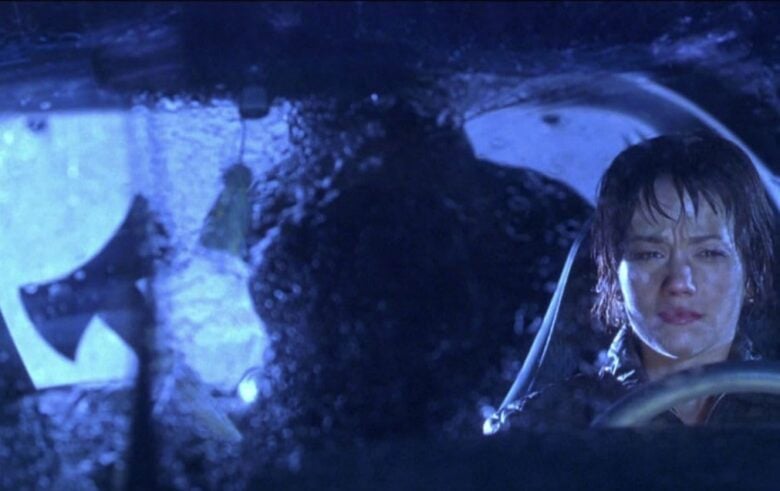
Image credit: Tristar Pictures / IMDb
The killer in the backseat
The urban legend of the killer in the backseat has become one of the most enduring cautionary tales about the dangers lurking in everyday situations. According to the story, a woman driving alone at night notices another vehicle following her closely, repeatedly flashing its high beams in what appears to be aggressive or threatening behavior. Terrified by this apparent stalking, she speeds toward home or a safe location, only to discover that the other driver was actually trying to warn her about a dangerous intruder hiding in her backseat. The flashing lights were signals intended to frighten away the would-be attacker, transforming the perceived threat into an unlikely guardian angel.
This narrative draws inspiration from genuine criminal cases, most notably a 1964 incident in New York involving an escaped murderer who attempted to use a parked car as a hiding place. The criminal had concealed himself in the backseat, waiting for an opportunity to attack the unsuspecting driver when they returned. However, the vehicle belonged to an off-duty police officer who discovered the intruder and shot him before any harm could occur. Additional similar cases have been documented across the United States, involving criminals who used cars as temporary shelters or ambush points.
The stark difference between legend and reality lies in the absence of any protective figure or fortunate intervention in most actual cases. Real-life encounters with backseat intruders typically end in robbery, assault, or worse, with victims having no advance warning or mysterious helper to save them. The documented criminal cases involving car-based attacks reveal a much more brutal and random pattern of violence, where survival depends entirely on chance rather than the intervention of a concerned stranger flashing headlights.
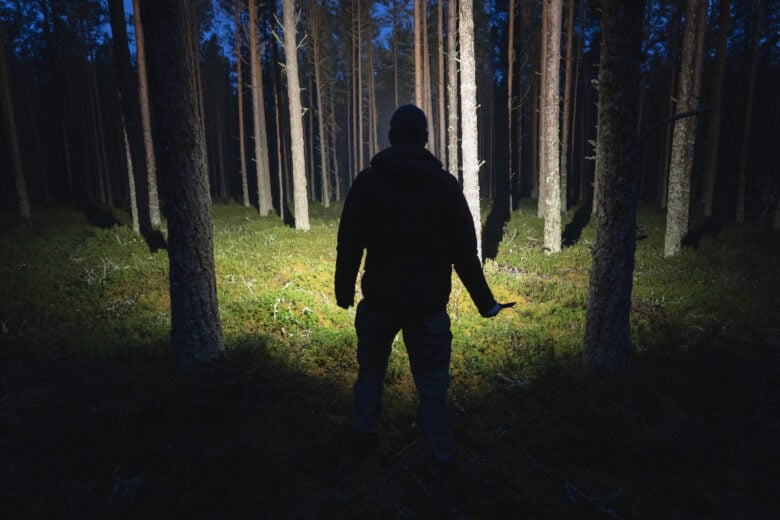
Image credit: Dmitri Toms / iStock
The disfigured man who haunts the woods
Western Pennsylvania folklore tells of a terrifying creature known as “Charlie No-Face” or “The Green Man,” described as a monstrous, faceless entity that wanders back roads during nighttime hours. According to local legends, this being glows with an eerie, supernatural light and appears suddenly to startle unsuspecting travelers. The creature has become deeply embedded in regional mythology, inspiring countless ghost stories and urban exploration adventures as people venture into the countryside in the hope of catching a glimpse of this mysterious figure.
The heartbreaking reality behind this legend centers on Raymond Robinson, a gentle man who suffered severe disfigurement as a result of a childhood electrical accident. At age eight, Robinson came into contact with a high-voltage electrical line near a bridge, causing injuries that left him without eyes, a nose, and one arm. Despite his kind and friendly personality, his appearance frightened many people in his community, forcing him to live as a virtual recluse. Robinson could only venture outside during nighttime hours when fewer people would encounter him, leading to his nocturnal walks along rural roads.
The transformation of Robinson’s tragic circumstances into a monster legend represents a profound failure of human compassion and understanding. Rather than recognizing the man behind the appearance, local folklore dehumanized him, turning his personal struggle into entertainment for others. Robinson actually welcomed visitors who approached him respectfully, often posing for photographs and engaging in friendly conversation. The true story of Raymond Robinson reveals how society’s fear of physical difference can create isolation far more terrifying than any supernatural creature, demonstrating that the real monsters in this story were never the disfigured man seeking simple human connection.
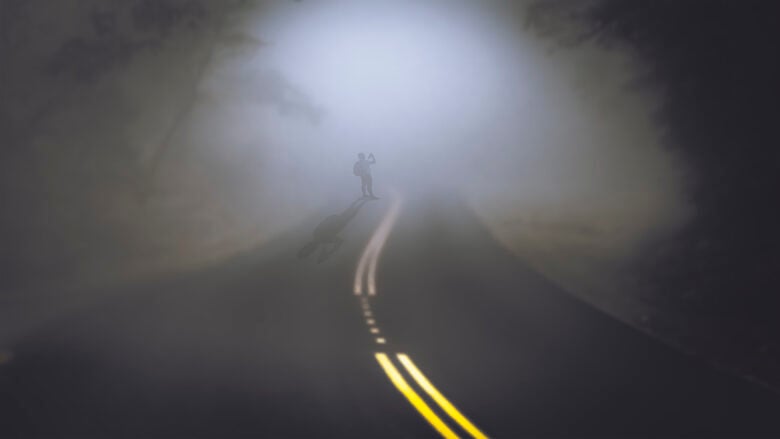
Image credit: Nathan McDaniel / iStock
The vanishing hitchhiker
The vanishing hitchhiker represents one of the most widespread and enduring urban legends found across cultures worldwide. The basic narrative follows a consistent pattern: a driver encounters a hitchhiker on a lonely stretch of road, offers them a ride, and engages in conversation during the journey. However, when the driver reaches the destination or looks back to continue the discussion, the passenger has mysteriously disappeared from the vehicle. Later investigation reveals that the hitchhiker died in an accident at that exact location, sometimes years or decades earlier, leading to the supernatural conclusion that the driver encountered a restless spirit.
This legend’s persistence stems from its connection to numerous documented traffic fatalities and missing person cases that have occurred along highways throughout history. Many specific versions of the story can be traced to actual accident sites where pedestrians or motorists lost their lives in tragic circumstances. The narrative serves as a cultural mechanism for processing the random nature of traffic deaths and the psychological impact these deaths have on local communities. Roads where fatal accidents occurred often become associated with supernatural encounters as people struggle to comprehend the senseless loss of life.
The disturbing reality underlying these stories involves the mundane horror of traffic accidents, which claim thousands of lives annually through mechanical failure, human error, or simple misfortune. Unlike the legend’s implication of spiritual continuation after death, real traffic fatalities represent final, irreversible endings that leave families devastated and communities searching for meaning. The documented accident statistics behind many vanishing hitchhiker locations reveal that our highways serve as sites of genuine tragedy far more frequently than they do of supernatural encounters, making the everyday act of driving a more legitimate source of fear than any ghostly passenger.

Image credit: n-s-d-/iStock
The corpse in the hotel water tank
Hotel guests occasionally report unusual tastes or odors in their tap water, resulting in complaints about water quality and requests for explanations from management. The urban legend version of this scenario typically involves the discovery of a decomposing body in the building’s water tank, usually located on the roof or in a basement mechanical room. According to these stories, the contamination continues for days or weeks before the source is identified, during which time unsuspecting guests consume and bathe in the tainted water supply.
This horrifying premise transcended folklore and became documented reality in 2013 when the body of Elisa Lam was discovered in a water tank atop the Cecil Hotel in Los Angeles. Lam, a 21-year-old Canadian student, had been missing for weeks before hotel maintenance workers found her remains in one of four rooftop water tanks. Guests had complained about water pressure issues and unusual taste in the days leading up to the discovery, unknowingly consuming water contaminated by human decomposition. The case gained international attention not only due to its disturbing nature but also because of security footage showing Lam’s erratic behavior in a hotel elevator shortly before her disappearance.
The Elisa Lam case demonstrates how reality can exceed the horror of any fictional narrative. The actual circumstances surrounding her death remain unexplained, with theories ranging from a mental health crisis to foul play, yet no definitive answers have emerged. The security footage of her final known moments presents a real-life horror show more unsettling than any scripted thriller, capturing genuine human distress without the comfort of narrative resolution. The Cecil Hotel incident forces us to confront the reality that such nightmarish scenarios actually occur, transforming what was once dismissible folklore into a documented fact that challenges our sense of safety in everyday environments.
Image credit: Francescoch / iStock
Conclusion
These legendary tales, when stripped of their supernatural embellishments, reveal a far darker truth about the human condition and the world we inhabit. The absolute horror emerges not from ghostly apparitions or mysterious phenomena, but from human cruelty, tragic accidents, and the inescapable anxieties that define modern existence. Unlike folklore, which provides moral lessons and narrative closure, reality offers no such comfort or explanation for the senseless violence and random tragedies that inspire these stories.
The transformation of actual events into urban legends demonstrates our psychological need to process incomprehensible experiences through storytelling, yet this process often obscures the genuine human suffering that occurred. As we dismiss these tales as mere fiction, we risk forgetting the real victims whose experiences were transformed into entertainment, and we overlook the ongoing dangers that these stories initially sought to address. The question lingers: what other narratives have we relegated to the realm of fantasy that might contain terrifying kernels of documented truth? Check out our other spine-chilling articles here at MediaFeed to explore more stories that blur the unsettling line between legend and reality.
Related:
- Metal heads: Can you guess the band by the urban legend?
- 10 secrets behind popular ’80s songs we bet you didn’t know
Like MediaFeed’s content? Be sure to follow us.
This article was syndicated by MediaFeed.org.
AlertMe